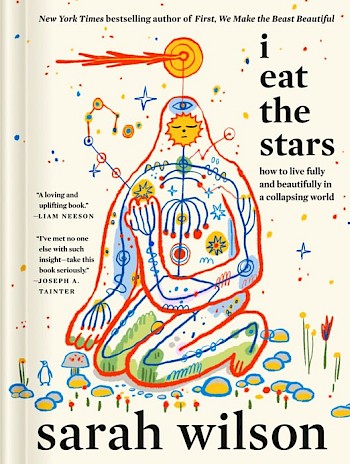
 Currently I mostly read articles on Substack and I read very few books. However, this book has been on my reading list for over a year. Having pre-ordered it, I Eat the Stars: How to Live Fully and Beautifully in a Collapsing World by Sarah Wilson arrived in my Kindle library on its release date of June 15, 2026.
About a year ago, I began following the development of the writing of this book on Substack, New to the Collapse Book Serialisation? Here's where you can get started.
This book report is my encounter with it, my commentary, my experience. My summary does not do this long chapter justice. Buy the book. Read the book. Have an experience.
The book begins with Praise for I Eat the Stars and I see some names that I recognize, names that many people would recognize—Liam Neeson, Joseph A. Tainter, Margaret J. Wheatley, A. C. Grayling, Alain de Botton. This is big league. I expect to see this book on New York Times Best Seller where Wilson has been twice before.
i’d love you to know a few things before we start
This book is not an easy book. It is about the collapse of the systems that once held our world together, and it requires facing a bunch of brutal truths and large feelings that perhaps you’ve been avoiding—for very fair reason.
Most people are not yet collapse aware. But it is my sense that collapse awareness is moving towards the mainstream on an exponential curve. Personally, I have been facing this brutal truth since 2019.
I also want to warn from the get-go that I won’t be providing fixes or solutions.
We live in a problem-solution culture. However, anyone claiming to have a solution to the metacrisis that is leading to collapse does not have a deep understanding of the current human predicament. Using her impressive skills, Sarah Wilson has put in three years of work writing this book and she is, imo, highly credible.
hope
So, you can see, we had to have hope that things would turn out… so that… things could actually turn out. Hope was what would save us.
But then it didn’t.
Save us.
...I put it to them: Are we going to make it? How are those deadlines going? They all told me that since I was asking so directly, they had to admit: The picture was no longer… hopeful.
“But what about your nieces and nephews?” “I know,” I said. It breaks my heart to say it, to type it. I no longer have hope.
I still have a tiny bit of hope. I think the Bend Not Break scenario advocated by Nate Hagens is possible, but not probable. In 2022, which seems like a very long time ago, Nate Hagens and Daniel Schmachtenberger discussed this at length in a five part series.
relief
Now, a strange thing happened. As I started to talk and write about this idea of no longer having hope, I was met with a very particular reaction: relief.
Yes, strange indeed. There seems to be a widespread, vague feeling that something is very wrong with our world and our leaders are not telling us what it is. When someone puts words to that feeling in a way that makes sense to us, there is relief from all the constant gaslighting.
truth
When I removed my own aching hope from the equation, when I freed myself from the tug-of-war between what I could plainly see was happening around me on the one hand, and the hopium on the other, I noticed that all that was left was… truth. And I began to see that truth is what could hold us instead. Indeed—and here’s the really hope-full reality—when we let go of hope, truth emerges as a far more solid and enlivening thing to peg a life to.
And from this expansive vista, we find ourselves with an overwhelming desire to… fully live!
At this point in my book report, I will repeat a very serious warning from Sarah Wilson:
This book is not an easy book. It is about the collapse of the systems that once held our world together, and it requires facing a bunch of brutal truths and large feelings that perhaps you’ve been avoiding—for very fair reason. So it may not be for you just now. And this is very okay. That said, I’d urge you to read the first three chapters and see how you feel. You can best decide from there.
I feel much like I have for several years. I have a line from a 1980s rock song on a loop in my head: It's the End of the World as We Know It (And I Feel Fine). I am not only collapse aware and collapse accepting, I am collapse activated, as is Sarah Wilson, willing and able to do something.
collapse
Let’s start from the beginning. In the past five thousand years there have existed dozens of complex civilizations...
Every one of them collapsed.
And every one of them collapsed because they became too complex.
This is a brutal truth that we need to face. Every civilization except the one we live in has collapsed. It takes supreme arrogance, or denial, to believe that this one won't.
I agonized over whether to even include this very long chapter.
I understand as there is a cost. I do not share my collapse awareness with everyone I know. It can be a lonely journey to see clearly what others cannot see at all.
The sense is that not everyone has the psychological capacity for the brutal details, and to impose the information on them is irresponsible—it could induce mass panic and untold emotional distress.
Fortunately, I can comfortably discuss collapse with my wife. And I have a group of trusted friends who have above average psychological capacity. But I also see potential for mass panic at some point that is not cotingent on the publication of any one book.
Could I hold it all—the “facts,” the fears, the nonlinear complexity, the emotional and spiritual fallout—responsibly?
What we can hold and how we hold it is one aspect of psychological health. Holding complexity, uncertainty and paradox are important, imo. And these are skills that can be learned.
I also think a lot of us here need to know that collapse is actually a thing. That it’s not some fringe conspiracy but a phenomenon that is being studied and tracked in universities and institutes around the world.
Holding collapse as a conspiracy theory is a form of denial by those who cling to Modernity.
It probably makes sense to start this exploration of multisystem collapse with climate collapse...
Well, it makes sense to Sarah Wilson, and many people, to start with global heating. But I was a profesional accountant and my orientation is financial. However, both the climate and the economy are complex systems and they interrelate in a larger web of many complex systems.
I have a very simple way to explain collapse. To save the economy, we must kill the earth. To save the earth, we must kill the economy. To save civilization, we must save both at once and no one knows how to do that. Hence collapse.
Sarah Wilson goes on to discuss issues familiar to those of us already collapse aware—overshoot, planetary boundaries, carrying capacity.
And now comes another very personal reason why I am collapse accepting.
In 1972, a group of esteemed thinkers and economists... the Club of Rome... ran comprehensive mathematical modeling of future growth and resource use, which resulted in the now famous The Limits to Growth report, initially published by MIT and then produced as a book that sold more than thirty million copies...
As a young man in the 1970s, I was aware of The Limits to Growth. But I did not change my behavior and lived a different narrative, The Myth of Progress. Collectively, humanity has long had the right knowledge while lacking the wisdom to act accordingly.
We didn’t stop. We didn’t heed the warnings.
For about a year or so, I struggled to comprehend that so many different things, indeed everything, could be going wrong... I began to find it weirdly helpful to view this everything through a systems-collapse lens... It’s systemic... A complex system of complex systems.
Again, my summary does not do this long chapter justice. Buy the book. Read the book.
spiritual
I, too, had been getting the deep sense that we were going to have to access a very different mindset to even begin to fathom what was going on around us.
What if all those spirituality insights that we’ve been flirting with for years, those mindful wisdoms in the books that sit on our bedside tables, and those aha aphorisms that hit us over the head at our yoga retreats… what if they are no longer mere wafts of peaceful “feels,” but instead are precisely how we will have to live now? To cope. To fathom. And to handle this perilous “meantime.”
What if spiritual awakening is no longer a curiosity that we toy with, but where we will necessarily be taken?
And here again we face a conundrum. We need a very different mindset but lack the institutions that generate such people. We need better institutions in order to build better people and we need better people to build better institutions. No one has figured out how to build better people and better institutions at the same time. Hence collapse.
When I was seven, I discovered I was able to rise above myself and see my existence from a god’s-view perspective. I would get this weird sensation that I was watching myself... Ever since, I’ve continued to try to touch this vastness and truth that exists beyond words and that the spiritual texts and teachers can only point to.
I’ve chased that “astral planing” sensation I accessed as a kid and that started to fade as I entered my teen years. I’ve read The Power of Now and studied the works of countless nuns, Buddhists, theologians, rabbis, poets, and mystics. I’ve listened to Alan Watts’s sermons, spent time with His Holiness the Dalai Lama, and I meditate.
I experience myself as ordinary and Sarah Wilson as extraordinary.
Our world is falling apart, and yet I feel a very particular peace and belonging in my being. And I’ve definitely got a hunch that we’re heading somewhere better. That we’re onto something important about being human.
liminality
Liminality is a lovely word... It describes a time or a space between two things... In liminality, one door has shut behind us, the next has not yet opened... In liminality, we grieve what has passed or died, as well as fear what’s ahead.
We are between an old world, or an old “normal,” that is dying, and a new world that’s yet to become.
The philosophical and scientific concept of emergence comes into play here... Its “becoming” is more than the sum of the parts from which it emerges... All complex systems emerge. And they decline emergently too.
The challenge before us, then, is to choose or to “decide” as a collective to emerge into our full collective adulthood and to provide the guidance to each other.
This is a challenge that I take personally, beyond collapse aware, beyond collapse acceptance, onward to collapse activated.
So now is as good a time as any to bring up why I uprooted my life and moved to Paris as I approached fifty.
This part of Sarah Wilson's book was very interesting but I am not summarizing it. Buy the book. Read the book.
Oh, and by way of a beautifully relevant postscript: The French interest in collapsology has been described by leading tech news website TechCrunch as “the latest manifestation of French existentialism, updated for the 21st century… in that… the only way to avoid collapse is to fully see the world in all its complexity.”
death
A bold, truth-based awareness of collapse slams us up against these kinds of existential questions. And up against a bunch of different kinds of deaths. The first, of course, is the prospect of our own death and that of our loved ones... The second death we’re being forced to face is that of humanity. Collapse seriously threatens our species with extinction... Before we wrap there is also a third death at play in a collapsing world. It’s the death of the “old normal”—all those structures, assumptions, and mindsets that make up our postindustrial civilization.
I live in a large retirement community. It seems to me that some people here have faced existential questions and many have not. I am struggling to communicate with those who seem to be in complete denial of the possibility of the collapse of Modernity.
I asked my community for their thoughts on the prospect of this third death... Many responses also reflected—again—that sense of relief... Some respondents got specific about what they would really be quite happy to see die...
Sarah Wilson is very good at engaging with her Substack community.
live
It’s to face our death (and the potential death of humanity, and the death of our old ways) now so that we can live now, without the regrets.
This is hard to explain unless felt, how facing death helps us to feel fully ALIVE.
A few weeks after arriving in Paris, I woke one morning to a call from my friend Nick. “I’m so sorry, it’s Tim. He’s gone.” Tim was probably my closest friend. He’d been my meditation teacher for a decade, then my confidant. And on a Monday in June, he hanged himself after a long wrestle with his demons.
Sharing this personal detail adds a dose of reality to the story of collapse.
These two chapters on death—and full, spirited living—took me many weeks to compile and to sit with... I knew I had to metabolize the truths in the still and unyielding truth of nature. And I had to move the information through my body. This stuff must have movement.
metacrisis
...I have found the most helpful term for what’s going on to be “metacrisis.”
I agree. Better than permacrisis. Better than polycrisis.
...there’s also an underlying crisis, which is loosely the original, collective mindset that allowed the polycrisis to come about in the first place. In most cases, this underlying crisis is the individualist, extractivist, colonialist mindset of postindustrialism. The crisis is meta because it’s so thoroughly self-referential.
No one caused the metacrisis. Everyone caused the metacrisis. We are participants.
Right now, some folk are getting tied up in intellect-swinging semantic spats trying to, well, own the metacrisis.
Yes, I see a lot of this in the metamodern SPACE.
But my response tends to be blunt: We don’t have the time for such indulgence. There is work to be done!
Yes. It is time to move beyond collapse aware and collapse accepting and to become collapse activated and to get to work!
Metacrisis framing also helps us understand that we are not actually crazy to be feeling this bamboozled. The metacrisis is crazy-making... “But this time is in fact different,” I said... I explained that the issue is complex and systemic... this time is different because our civilization is global.
moloch
It’s called “moloch,” and it’s a game theory concept named after a God in the Hebrew Bible... an invisible “force” that arises in competitive scenarios... a horrible race to the bottom... In a competitive system like our civilization, moloch emerges, mostly without our noticing, and becomes a force greater than our individual or collective will... Once the competition is entered, no one can stop, because stopping sees you lose. But not stopping sees everyone lose.
I am amazed by how much influence one article by one man, Scott Alexander, continues to have.
And I am amazed by how similar my journey has been to that of Sarah Wilson as I read a chapter with many familiar names—Liv Boeree, Tyson Yunkaporta, Marc Andreessen, Geoffrey Hinton, Elon Musk, Sam Altman, Nick Bostrom, Mark Zuckerberg, Peter Thiel, Douglas Rushkoff, Curtis Yarvin, J. D. Vance, Carole Cadwalladr, Jeff Bezos. Noteworthy, imo, is that the bad guys outnumber the good guys in this list.
post-blame
Given that we’re all trapped in a moloch hellhole, given the complexity is so very literally unfathomable... I wonder if we could forgive each other. And ourselves. For, you know, fucking things up.
In this chapter, Wilson moves from understanding the predicament to what we can do. Yes, I was captured by the myth of progress and I have forgiven myself. And I am working on being more forgiving of others still trapped in Modernity.
It’s a question. And an invite. And a strategy.
In her viral essay “Facing Extinction,” the Buddhist writer and elder Catherine Ingram writes: “Nearly all of us went along on the ride and enjoyed the benefits, and now the party’s over, and the bill has come due. But where can we lay blame?”
Yes, I went along and almost everyone around me went along.
I condemn the behavior of every narcissistic, hedonistic, immoral, and, in many cases, murderous player operating within these behemoths; they should be held to account and punished.
Yes, forgive and punish.
There’s also the Shirky Principle, named after tech writer Clay Shirky, who first identified the phenomenon, which states: “Institutions will try to preserve the problems to which they are the solution.” That’s what they do... I mean, it’s all moloch. It’s the growth imperative doing its thing—keeping the whole pileup trundling forward. It’s complex systems doing what complex systems do.
I have observed many around me expressing similar compassionate and wildly forgiving sentiments for humanity as they’ve progressed further into collapse awareness.
Dear fellow humans, we need to make peace with our fuckuppery (which we are both responsible for and not responsible for).
It seems to me that Sarah Wilson has more than a little bit of WISDOM.
Many of us here are looking for a way, a strategy, a mode of being for simply living out a life in these baffling liminal times. A growing body of evidence is showing that practicing forgiveness gives us more of a sense of agency in compromising scenarios than seeking revenge or or blaming.
In many ways, facing collapse provides us with the clarity and serenity to know what we can change and what is truly a distracting, life-threatening waste of energy. This kind of acceptance and forgiveness is hard. It requires a radical acceptance and forgiveness.
denial
I think understanding how and why denial works is crucial to this process.
...we are evolutionarily programmed to maintain confidence in a collective worldview, which is another form of denial. The cultural anthropologist and Pulitzer Prize winner Ernest Becker famously argued that many of us manage our existential fear by subscribing to culturally constructed beliefs that tell us we’re valuable people in a meaningful meaningful universe.
I very much appreciate how Sarah Wilson points to our evolutionary programming as foundamental.
The bulk of life works to reduce entropy, per the second law of thermodynamics.
I very much appreciate how Sarah Wilson points to scientific law.
As our complex civilization has provided more avenues for escaping discomfort rather than facing it... This has meant that tolerance for diverse viewpoints and the ability to work through complex issues has diminished...
Most people do not have such an understanding yet; our world stubbornly operates to a linear worldview.
Most people need to be in denial.
...it can be hard to hold firm to the new ideas being presented in a book like this while still paying off a mortgage, trying to get the kids to school, and, yes, maintaining relationships with people who are not seeing things as we are.
Yes, it is hard and has cost me one long-term friendship and changed my engagement with other friends, and family.
How do I convince other people about collapse?
...most people around us simply do not have the cognitive or emotional capacity (due to maturity, having too many competing pressures, past traumas, or maybe even too much privilege) to process the information and to resist their denial, and they could react aggressively, digging down further into their cognitive buttressing if we push it on them... We can’t afford to have large swaths of people freaking out.
Yes, more WISDOM.
Waking up is lonely... I have also lost a few friends to this odyssey...
I struggle to find a better suggestion than the noble project of creating “islands of sanity,” a concept Meg Wheatley devised almost a decade ago... Islands of sanity are intentional spaces, conversations, even ways of being, in which calm, considered, accepting, forgiving responses and approaches are lived out. These islands are not places where we fix the whole system. They are where we preserve human values, sanity, and coherence in small communities in advance of the chaos ahead... We don’t just build these islands. We also be islands of sanity. We be the invite.
I have a few final but important thoughts to complete my answer.
Firstly, one must constantly check one’s smugness!
...we need to be conscious that we’re not managing our own fear... by seeking refuge in being right.
Finally, it’s possible that each of us will need to retreat into denial at times...
uncertainty
I take a deep breath and... calmly explain that the uncertainty is, in fact, the point, it’s the central threat.
The future is uncertain and never more uncertain than now.
...we’d be well advised to build our tolerance of uncertainty in order to better manage tricky times in our lives... We must now become fiercely warrior-like in our ability to sit deep in uncertainty, ambiguity, confusion, and the terrifying unknown... we’d do well to delight in uncertainty.
And this is best done in islands of sanity with trusted others.
...the brain is at its best when it is constantly rewiring itself and making new connections—dealing in exciting new directions. You know, dancing with life as it’s happening.
No matter what happens—amid all the unknowns—we can simply opt to fight for life, beauty, and love. We can choose to be in the uncertainty and ask those different types of questions.
anti-chaos
I’d like to run a cursor over a few of the key tactics being deployed by various nefarious forces... “The goal is permanent unrest and chaos within an enemy state.
No one can grab on to anything… This is how I feel so much of the time... The world’s insane; nothing makes sense, I cry.
Again, we need islands of sanity and I am very grateful that I have found one.
All these chaos tactics serve the same function. The conspiracies, the woke slinging matches, the gaslighting, the straw-manning and bullshitting, the grift, the zone-flooding, all take up our time, resources, and emotional balance...
...we can then consciously opt out of the game. I will not play!
Yes, we can play our own game.
We must show up to life with everything we’ve got. It takes courage... Thinking has become a lost art...
Yes, it seems thinking is currently undervalued and I deeply appreciate Wilson's support of my core orientation.
ungrowth
This is the feeling I have now as I move on from the growth myth. There’s that famous line attributed to Kenneth Boulding, himself an economist: “Anyone who believes in indefinite growth in anything physical, on a physically finite planet, is either mad or an economist.”
Only in retirement did I finally move on from the myth of progress.
We also tend to conflate growth with progress... No doubt this conflation is correlated with our concept of the arrow of time, a left-to-right “forward” thrust. Of course, for a long, long time, growth did mean better.
As an aside, I hope to write an essay sometime about the significance of the arrow of time.
...life and evolution don’t work to an infinite upward trajectory. They operate in cycles of growth, maintenance, and… destruction.
Modernity seems to be in denial of the destruction part of the evolutionary cycle.
I have followed all the alternate “degrowth” models that have been put forward by brilliant and generous minds around the world... They are all amazing, clever, beautiful ideas. But the problem they all face is that timing issue—most of the models can no longer be implemented in time to meet those climate and resource-limit deadlines... My sense is that none of them can get off the ground without the system being overhauled.
Hence collapse. This is a hard truth that most people are in denial of. However, grasping this adds meaning to our lives, informing what matters now.
“Only a crisis—actual or perceived—produces real change. When that crisis occurs, the actions that are taken depend on the ideas that are lying around.” ...They will be there ready, to carry us into the “what comes next.”
My journey with trusted others is one of co-creating one of the ideas that we hope will still be lying around after collapse.
simplification
But I want to stress here—and perhaps I should have said it much earlier—collapse won’t be like in the movies... Collapse will likely be vaguer, more complex, more uncertain, and less climactic than that... Collapse also looks deceptively normal.
And once again, I am struck by how similar my journey has been to Wilson's. The same people make sense to us. More than any book I have ever read, I eat the stars captures my thinking but with much more skillful writing.
...Nate Hagens calls collapse a “great simplification.”
Vinay Gupta... goes this far: “What you people call collapse means living in the same conditions as the people who grow your coffee.” Which really hits things home, I feel.
Given all this, should I be stockpiling? Should I be prepping? Are you prepared to then defend the stockpile? With guns? What about when the neighbor’s starving children come around? I’m not. And couldn’t.
In the event of collapse, there is little doubt in my mind about what would happen here in Mexico where I live. The cartels would eat because they have guns and the will to use them. At some point of collapse, which I hope does not come in my lifetime, it woiuld be better to die.
...fewer than 5 percent of intentional communities last more than five years.
Building an intentional community in anticipation of collapse is, for me, a waste of my remaining time.
I’ve so far resisted the pull to provide lists of “actionables” and fixes in this book (as I said from the outset, this is mostly because there are no such fixes to predicaments). But I’ll now provide two loose rundowns. The first, below, is a list of mindsets, reflections, and wisdoms for emotionally decoupling from things... After our basic needs are met, the best things in life are mostly free.
I have an image in my head of my parents reading Alvin Toffler’s 1970 cult book Future Shock on a camping holiday.
And I read Future Shock in the 1970s. I have long been aware of the ever increasing pace of the rate of change. And now it has been given the biggest boost ever with the arrival of AI.
The second loose rundown is a very incomplete compilation of practical, tangible ways we can go about “simplifying now”... Speaking tangibles like this suddenly makes things starkly real for many... There will be tears ahead. The change will feel surreal. The enormity will feel wrong. You will doubt your deep intuitive sense that collapse is real and must be faced now... But, super importantly, you are also allowed to enjoy this new life.
duty
...one thing we can rely on to give our life meaning is our commitments... I keep coming back to this compelling commitment because it feels meaningful.
...where we should now be steering our efforts, our commitment. What was the priority?
I’ve already outlined the many reasons why I can no longer support the idea that “we can still make it,” that we can bring global warming and emissions down within those ranges we were told about for years... The hopeful/wishful messaging also ignores the fact that global warming is only one part of the problem...
I agree.
When Project Drawdown founder Paul Hawken and I spoke partway through my research into all this, he admitted he had come to the same conclusion (after decades of pushing the green growth message). “We’ve been hoping for the wrong thing, for a thing that makes no sense,” he said. “Fixing the planet when the planet doesn’t need fixing… we do.
Yes, we need fixing, human beings need an upgrade, and working on that problem is meaningful.
Yes… and we must pick the right fight... It must be about democratizing survivability, ungrowth, simplification, and preserving our humanity.
I spoke to the Canadian Indigenous knowledge academic Vanessa Andreotti about this.
And once again I see that Wilson is talking to the same people who I have found worth paying attention to.
Efforts to help a frightened, fragmented, bewildered humanity adapt and adjust to the challenging times ahead will, for instance, help us “handle it” and reduce the risk of that mass social unrest that could flip the whole enchilada.
Again, more WISDOM.
To start, we need to accept that there is no centralized, coordinated organization that can coalesce all of us so we can make the biggest impact with wondrous critical mass. My advice is to get cool with the idea that the opposite setup is going to be the better way now. Self-organized, organic, local groups that work bottom up are way more aligned with the complex mess we’re in, and with the emergence that will steer us going forward... Collaborate, cooperate, and communicate. These actions can seem a bit soft, and you might be inclined to dismiss them. But soft skills are precisely what’s going to be required in our future world together.
Jem Bendell, in Breaking Together, says the most important thing to do is to talk to like-minded people.
Bendell is also someone that I have paid attention to, although not recently.
If all else fails, or you lose focus, just care.
Should I be having kids in a collapsing world? ...Since the beginning of time, people have had children in dark times who, often, grew up to experience horribly declining conditions throughout their entire lives. I would argue until the end of days that their lives are worthy and that their contribution is entirely necessary.
Good advice but many times my wife and I have said to each other thank God we have no kids.
pain
I have despaired and grieved deep on this ride. I have felt regret that I allowed myself to be lulled into false hope for so long. I have felt betrayed by the emptiness of the postindustrial promise. I have felt shame for the violence we’ve we’ve committed to nature. It happened on my watch! I have also felt a profound sadness that I’d never dared touch before as I separated from friends and family who continue to cling to the mast of the postindustrial system as it sinks.
Personally, I lived by the myth of progress until 2016. It happened on my watch and I contributed to our predicament. I feel sadness but not shame as I have forgiven myself. And I am experincing separation from friends and family who cling to Modernity.
Professor of Cognitive Science at the University of Toronto, John Vervaeke, has written that as we become aware of what we have done to the world and each other, “We no longer believe in ourselves..."
Vervaeke is a familiar and respected name to me and I agree. It seems now to take irrational faith to believe that human goodness will prevail. But try we must.
...when we really do despair, when we go down fully into the absurdity of having been born into a painful human existence that we know will end and that we decide to trudge through regardless, something in our humanity kicks into gear that must transcend the despair. It really must, for otherwise we would self-annihilate... It’s a lot. But bear it we must. We must find all the different ways to do this.
There have always been wisdoms that guide us through despair and grief... most of them can be crudely distilled down to four truths... The first is that this kind of pain (grief, despair, ambiguous and anticipatory loss) is best sat in and passed through in community... Second, we must cry. My goodness, I have to cry a lot these days... Thirdly, we must be courageous. And, yes, radically so... Finally, we take all this and we be of service.
The pain that Sarah Wilson feels and expresses so well seems very real to me.
oh, and we can dance!
I must say that while I love the metaphor of dancing, I hate to dance, always have, a part of my personal journey.
French historian Philippe de Félice wrote, “Eras of greatest material and moral distress seem to be those during which people dance most.” ...Which then got me curious about why dancing “works.” ...When we dance it is said we are processing despair, grief, shame, terror, fear at a biological level.
After my ayahuasca experience, I took to dancing... I often cry as I dance... On our islands of sanity, shall we dance?
I appreciate Sarah Wilson sharing her lived experience.
And yes, on our island of sanity, WE dance with our trusted others.
humble
When I was thirty-four, I disappeared. I could no longer see myself in the bedroom mirror that I’d been staring into, sideways, from the floor where I’d been lying in a twisted fetal position for three days. I had been in a dangerously suicidal ideating spot and was ready to step off. For more than a year, I’d been very unwell with a serious autoimmune condition, unable to work or walk.
Again, I appreciate Sarah Wilson sharing her lived experience.
I once very seriously considered suicide but only for a short time. And I was able to work and walk. But for five or six years in my early fifties, I was in a state of dispair.
I (evidently) chose the latter route. I chose to fully embrace my “not mattering” and to join life where it is at.
I understand from my own lived experience. Considering suicide, I felt that I did not matter to anyone and not even to myself. But coming out alive on the other side, I have been living the best years of my life.
An important part of what we’re going through here must entail sitting with the realization that we are simply not as great as we thought we were.
We are not that great, not personally and not as a species.
Of course, there is no instruction manual for becoming humbled by this collapse process.
But,
Being humbled by life, by collapse, can also be supremely beautiful, connecting, and uplifting.
We have been gifted the ability to ponder and to rejoice in—to figuratively eat—the stars.
Here I think Sarah Wilson missed something important. It is not figurative. We ourselves are made of stardust and what we eat is stardust. This is what I assumed her book title meant. But she explained that the title came from a poem, “Antidotes to Fear of Death” by Rebecca Elson.
Dear friends, humans were never promised comfort, endless good times, infinite growth, or the right to “win” and conquer all. We were, however, offered the gift of life. The opportunity to love, to ponder, to marvel, to find it all magnificent and beautiful.
I agree.
wisdom
I must admit that I was somewhat disappointed with this chapter.
Over the course of this journey, it’s become increasingly obvious that we need moral guardrailing and wisdom more than ever... We need wisdom to guide us into the entanglement so that we can emerge into what I continue to believe could well be a better, braver new world... Worryingly, though, our culture has lost wisdom. Not the wisdoms themselves, but the reverence for and practice of them.
I agree.
I’m now going to draw heavily on the work of psychiatrist Dr. Iain McGilchrist; a lot of people in this space do.
Iain McGilchrist is currently a highly prominent and influential figure within the cultural and intellectual landscape whose popularity has grown exponentially over the last few years. Although there is plenty that I like, personally I would not start a chapter on wisdom with him. But this is not my book.
The truly awesome Dr. Jill Bolte Taylor...
This is not someone I am familiar with.
...my publisher, Amy, has asked that I share a few things that I do to lean right, to cultivate wisdom...
Being in the question often means being wise enough to allow for unanswerable questions.
I agree. I have had acquaintances who dismissed all questions unanswerable by science as meaningless. Not wise.
But I... think it’s a responsibility to prioritize wisdom...
adulting
In developmental psychology, an inability to see the world through any lens other than that of our own self-interest is associated with immaturity... our civilization might be suffering from immaturity... We’re a reckless, overconfident teenager... I would even argue that in recent decades, we’ve actually been regressing...
...Americans—and American culture—have become significantly more anxious and avoidant, fleeing commitment and responsibilities when things get challenging.
As I Canadian looking at American culture from the outside, I agree.
We cocoon ourselves in the childish desire for comfort... I don’t let myself off the hook here.
Yes, all of us including Canadians, including me, have been childish.
According to this theory, the old worldview must first be seen for what it is, to allow for the new way. In Jungian terms, this is seen as true maturation, where the Self can hold both its light and shade.
Sarah Wilson turns in a direction that I quite like.
The female thinkers and commentators in the collapse and activist spaces also tend to take on an empathetic, holistic, and often spiritual approach that’s about serving the collective. They don’t promote wading in and being heroes. Rather, they advocate getting jobs done, drawing on “soft skills” of cooperating, coordinating, restraining, allowing and bearing, and, to be honest, being mature. I cite many of them in this book: Meg Wheatley, Donna Haraway, Vanessa Andreotti, Rebecca Solnit, Catherine Ingram, Joanna Macy, and Nora Bateson.
Throughout history, mature women, finally freed of child-raising responsibilities and many of the constrictions society has placed on them, have played important roles in steering communities and in fighting for justice.
Will Ferrell suggested the same in a speech he gave at a Hollywood Reporter event: Isn’t it just time for women to run the planet? I swear, but I don’t know what else to do because we—men… and we’re not doing so good. So, please, can you guys just take over?
I spoke about all this with Vanessa Andreotti... step forward into a sort of female elderhood role... connected to the feminine who don’t seek to be heroic warriors or elders but who are having the important conversations at kitchen tables and building those islands of sanity. Because it’s just our turn.
we must create art in the apocalypse
Is it appropriate that we be making art when the world around us is suffering and disintegrating? ...my answer is a hard yes! In fact, we must.
I look around the world at the moment. In my own circle, it’s the creatives, not the corporate lawyers or the accountants, taking a stand on social platforms, expressing the collective’s outrage.
Although I was a career accountant, I do not disagree.
...it’s the artist who actually first notices the shift in the Zeitgeist... artists tend to be the first to start reaching beyond the darkness.
A rivalrous product or idea sees one party gain from others’ loss. Most of what fuels today’s economy and culture is rivalrous. But things like music, art, writing, and even jokes go the other way. The value to everyone increases the more others consume it. They are anti-rivalrous.
It seems that we need less rivalrous and more anti-rivalrous.
We need to make art to remind us of what it is to be human.
reckoning
As we just covered, over and over the collapse process is shoving us unceremoniously into our humanity... Naming and talking about a thing transforms the thing into something meaningful.
BUT,
Sarah, what if we are wrong about this? ...Does it matter if we are wrong? ...Even if it were possible, would we want to preserve or reinstate the old normal?
NO! We want a better world, a much better world. But I do not think we are wrong about collapse.
We are creators and destroyers, beautiful and cruel. And we are always, always capable of more. Our story really should not end here... it is very probably our mission—our “why”—to rise to the complexity of life in a more beautiful way, not to give up.
Collapse might just be a matter of life unfolding in its own, knowing way, correcting for excess and other imbalances and driving humans (back) to who they really are.
humaning
What exactly is left when we lose it all? ...Who we are is what collapse can’t take from us.
Good question.
In the past, when people have said things like “love is all there is” and “only love remains” I’ve been left untouched, even cringing slightly. But being in collapse has taken me to a chasm of loss where such truisms bear out. The hypothetical “What is left?” suddenly becomes a lived and urgent question that has only one answer.
For me personally, this remains trite and cringworthy. Only one answer does not resonate and my path is differs. I am not at all critical of Wilson, just noting difference without conflict.
The distractions of yore don’t cut it anymore—small talk kills me (more than it did before), watching funny social media memes feels far too decadent.
This resonates!
But now I’m acutely aware that no one knows anymore. There are no right answers to be had.
And this resonates!
It hits me profoundly, in an embodied way: The love was there all along! It was what I was falling through and into. This is what is meant by “love is all there is.” Extraordinarily it’s taken collapse to land me at this damn truth! I’m certainly laboring this “love is always there” point.
Yes you are Sarah. Love is all there is is not a truth. It is a story, a meaningful, useful story.
I feel compelled to include one last list, a list of things we are radically ready for.
Again, I am feeling difference without conflict.
We really are ready to suffer nobly. Suffering is what humans do and we are built for it.
Most of us are not suffering very much yet and I am uncertain how ready I am.
And boy are we ready to let go of our individualistic stories.
No. Letting go of our individualistic stories is a story.
I truly believe relief is our nervous systems telling us we’re coming back into alignment.
I am not feeling the suffering nor am I feeling the relief.
We are ready to be more generous and to let go of possessions.
I have not become more generous with my donations to Foodbank Lakeside. I will continue to eat out at restuarants and enjoy doing so. And my smart phone and computer will soon need replacing, possessions I am not willing to let go of.
And we’re hell-ready to be in our feminine strength a lot more.
This is energy that I do feel, a story that I quite like.
We are ready to cry, to let our hearts be moved by sweet and sad things. I actually encourage everyone I know to cry as often as possible.
I do feel sad but I do not cry very much. I encourage everyone to cry if you feel like it. But I am okay with those that who do not cry.
And we are so, so ripe to be freed of the pressure to achieve what we’ve always known to be soulless goals.
Yes. Looking back at my forty-three year career, much of it was a soulless experience that I barely survived. I love retirement.
homecoming
It’s been almost three years of swirling research and twelve months of corralling these eighty thousand words into twenty-six chapters, and I have to tell you, my journey to landing into myself and humanity has not been all soft welcomings and glorious awakenings.
This whole book has felt totally authentic. I have deeply appreciated sharing this journey with Sarah Wilson. What she did in three years was a very similar six year experience for me. We explored much the same territory. She has captured so much of my personal journey in her many words and chapters.
The other personal collapse that’s been going on for me has been my own aging process.
At age seventy-four, strangely, contrary to reality, I am not feeling the aging process but I am aware in my head that this is the last chapter of my life.
But, really, this moment belongs to our entire civilization.
Not yet. Many are not collapse aware. Many remain trapped in Modernity.
As I tried to find a way to write this final chapter, I went back and skimmed my previous book, This One Wild and Precious Life, which chronicled a three-year odyssey hiking around the world in the footsteps of philosophers and polemicists to find a path for “solving” the climate crisis... But there was a major difference—I was advocating that we did these things within the system... The system is going down.
But the system is not going down without a fight.
I wrote this book not to provide an answer, but to lay out a way of being. A way to live a meaningful, human life with agency amid what is going on. And one that can best carry us forward into our new era... I try to strategize a path out. But there is—I promise you—nowhere to go. And so I bear it. I bear it. You will no doubt lose so much, you already have. I’m so, so sorry. But you must bear it too... There is no longer “hope”… and there is something else going on.
Finally, thank you to whatever strange, insistent force (Life?) that surged through me as I grappled all the way to this final… line. You are sacred!
No, Sarah, I am not sacred. I am secular, comfortably secular. But sacred is a meaningful and useful story.
This seems like a fitting place to stop quoting Sarah Wilson and add a few closing thoughts of my own.
More than any other book ever, this one captured my own lived experience. That motivated me to go deep and write this lenghty book report. However, there is more to the story that Sarah Wilson tells. Her version is incomplete but that is not a shortcoming. No one person can tell a complete story of a topic as big as collapse.