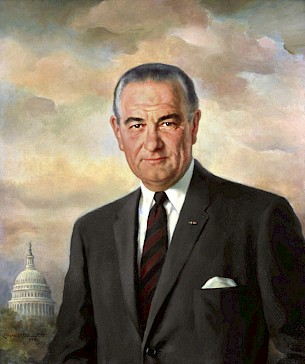
I was a teenager in the 1960s and became quite interested in the world in which I lived. Although Canadian, I was aware that LBJ, Lyndon Baines Johnson, was president of the United States. I knew about his grand ambition to build the Great Society.
Today I am one amongst the millions who follow Heather Cox Richardson and I read May 22, 2026, with considerable interest.
On May 22, 1964, in a graduation speech at the University of Michigan, President Lyndon Johnson put a name to a new vision for the United States. He called it “the Great Society” and laid out the vision of a country that did not confine itself to making money, but rather used its post–World War II prosperity to “enrich and elevate our national life.” That Great Society would demand an end to poverty and racial injustice.
Now over sixty years later, most of us would probably agree that we live in a Not So Great Society.
As the convenor of a new Substack, Final Waive Feminism, I am now paying a lot more attention to the voices of women. Some of them are focused on dismantling the patriarchy. And some of these women are making good sense to me.
However, I am now trying to reconcile the dismantling of the patriarchy with the intentions of LBJ.
Why did the Great Society not actualize? It seems too easy to blame the Vietnam War and Richard Nixon. And today it seems too easy to blame the patriarchy for the Not So Great Society. Yet it also seems to me that these are indeed pieces of a bigger puzzle. What additional pieces do we need to identify?
Historians, including HCR, do not describe LBJ as a nice man. His deep empathy for the poor seems authentic and his intentions were good. But he was also a rugged Texas rancher who projected an aggressive, hyper-masculine image to establish dominance. His style was that of a bully, intimidating and manipulating others, bending them to his almost superhuman iron will.
And what does the record show?
The LBJ legacy, as summarized by AI:
Lyndon B. Johnson left behind one of the most transformative and expansive legislative legacies in American history through his "Great Society" initiatives. His unparalleled mastery of congressional mechanics enabled him to pass the landmark Civil Rights Act of 1964 and Voting Rights Act of 1965, which legally dismantled Jim Crow segregation. He permanently reshaped the American social safety net by establishing Medicare and Medicaid to provide vital healthcare access to seniors and low-income families. Furthermore, his aggressive "War on Poverty" introduced lasting educational and nutritional programs like Head Start and the modern food stamp system.
But I am no defender of the patriarchy and on Final Waive Feminism I hope to say much more in coming months.